Knife-ear
The Ballad of the Last Dragon“Knife-ear” is an anti-elf slur whose decisive force lies in the gap between its apparent reference to pointed ears and the social violence it carries. In the narrative, the term does not merely describe Sylvaine Abelan as elven: it announces that her body places her outside ordinary protection, entitled others to command and abuse her, and can be used to turn public prejudice into private fear. Its repetition traces the movement from external persecution to internalized shame, and finally toward a refusal to let an oppressor define what an elf is.
The Slur as Social Classification
“Knife-ear” appears in a tavern as a declaration of exclusion. When a hostile customer yanks Sylvaine Abelan by the shoulder, tells her that she is lucky to have been admitted, and orders her to fetch drinks, he uses the slur to present her presence itself as an offense. The insult is inseparable from the threat of physical punishment: the speaker does not treat her as a guest or an equal participant in the room, but as someone whose kind can be disciplined at will. Her body reacts before she can answer. Her throat tightens, her chest fills with cold, her legs go numb, and panic threatens to overwhelm her, showing that the word draws power from a history of encounters rather than from the immediate exchange alone.
Jaromir’s response identifies the term as unacceptable even when Sylvaine Abelan tries to reclaim it as a factual description. After the tavern turns violent, she worries that the group will be remembered as the people who brought a “knife-ear” into the establishment and caused a bloody riot. Jaromir tells her not to call herself that. His objection distinguishes ethnic identity from the vocabulary imposed upon it: being an elf is not equivalent to accepting the name hostile humans use to degrade elves. Sylvaine Abelan’s brittle reply makes the larger history explicit. This is not the first time she has faced such treatment, nor the worst, and her near-hysteria reveals how a compact insult can reactivate accumulated danger.
Childhood Violence and Internalization
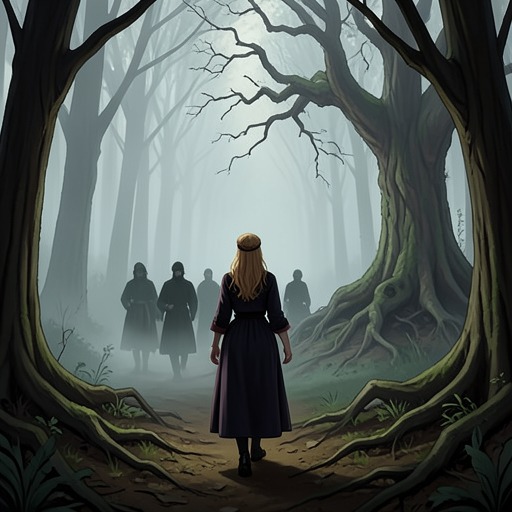
Sylvaine Abelan’s earliest memory of the term is bound to displacement and survival. As a young elfling, she arrived at a port alone and starving, then began stealing food: first an apple, later bread and even a mincemeat pie. Those acts initially represent freedom in an unfamiliar world. Food proves that her parents’ sacrifice to send her somewhere safer was not in vain, and the ability to move unseen seems to promise a life in which her ears will not make her a hunted creature.
That fragile safety collapses when she reaches for a braided sugar cake and is caught. The townspeople strap her to a post in the middle of town, whip her until she screams, bleeds, and vomits, spit on her, and call her a thieving “knife-ear.” She remains tied there through the night, covered in blood, vomit, and tears, while her punishers claim to be teaching her that stealing is a sin. Instead, the experience teaches her that being caught is the danger. The slur fuses a minor act of theft with an inherited racial category, transforming punishment into a lesson about social vulnerability: even in a place where she hoped to disappear, her elven identity can still be summoned as justification for cruelty.
Reversal Through Resistance
The word returns during Donnick’s assault on Sylvaine Abelan, where it functions as a verbal marker of attempted domination. After she is discovered and attacked, one of the men calls her a filthy “knife-ear” while the others climb toward her. She answers with immediate physical resistance, striking the tall blond man in the nose with a stone before being pulled from her hiding place. The violence that follows destroys her lute, stuffs her cap into her mouth, forces her to the ground, and pins her wrists and legs. The slur therefore accompanies an assault intended to silence both her speech and her artistic identity.
When Sylvaine Abelan later holds a sword against the wounded man’s pulse, the insult’s power undergoes a reversal. She recognizes that killing him would let his death remain as a permanent companion to her fear, even though the moment gives her the power to command fear in someone else. Her decision to stop is not surrender. It refuses the logic by which violence must reproduce the categories that enabled it. She lowers the blade, backs away, and admits the shame that follows the release of that power; yet she also states, “I’m not human,” and immediately rejects the implication that the slur has defined her, adding, “Nor do I want to be.” The declaration separates elven identity from the aggressor’s hierarchy: she refuses both assimilation into the humanity that has persecuted her and the violent identity that persecution tries to force upon her.
From Insult to Political Challenge
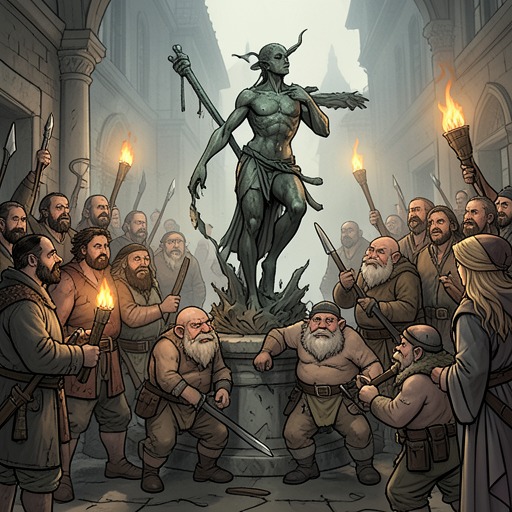
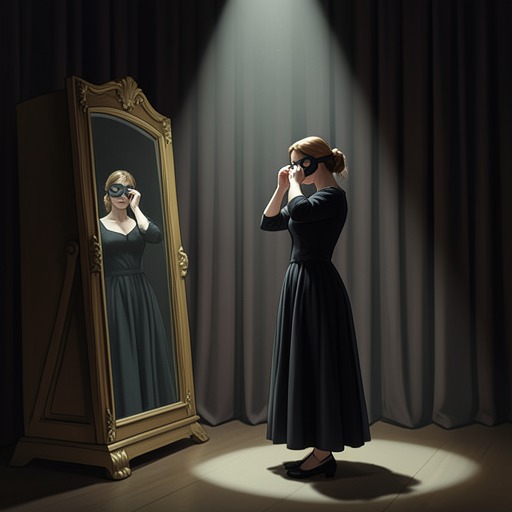
The slur’s meaning extends beyond scenes of direct violence because it belongs to the same order that makes elven lives precarious. In the confrontation over Rhosyn’s home, Sylvaine Abelan does not answer anti-elf contempt with another private act of revenge. She helps convert vulnerability into a demand for enforceable rights. Rhosyn calls on Magistrate William M. Ridion to abolish the inheritance law that can cast people from their homes after family tragedy and to adopt Queen Dhara’s inclusive policies on land and titles, so that any person can build a life in Kalinia. Sylvaine Abelan supports that demand with a legislative document prepared at Rhosyn’s table and threatens to expose the magistrate’s conduct through her performance if he refuses. The scene relocates the struggle over names and belonging from the abuser’s mouth to the institutions that decide who may remain secure. The same performer whose elven body has been treated as grounds for exclusion now uses authorship, public speech, and legal procedure to challenge rules that make dispossession possible.
That movement also shapes Sylvaine Abelan’s response to the rescue of elves fleeing persecution. When she learns that the rescuers charge nothing for transporting them, relief replaces suspicion: the escapees are not being exploited by people profiting from their flight from death and dismemberment. The detail gives the slur a wider social context. “Knife-ear” is not an isolated insult exchanged between individuals, but one expression of a world in which elven people can be hunted, displaced, and treated as commodities or criminals. Against that world, free transport becomes a practical counterstatement: elven survival is a responsibility rather than an opportunity for extraction. The narrative thus ends the term’s trajectory not with a new definition for the insult, but with acts of protection, legal reform, and collective aid that deny the social system behind it the final word.